
Our campsite at the second meadow served us well. It had some level tent spots. The deer munched and frolicked in the meadow in the evenings. The creek was nearby and wood was plentiful. The trail was on the other side of the meadow, so few people even knew we were there. Most of the crowd likely passed this spot up for destinations further up the trail. We wanted a fire, as the nights at this time of the year are chilly, so we camped by this meadow. This shot was taken early in the morning.
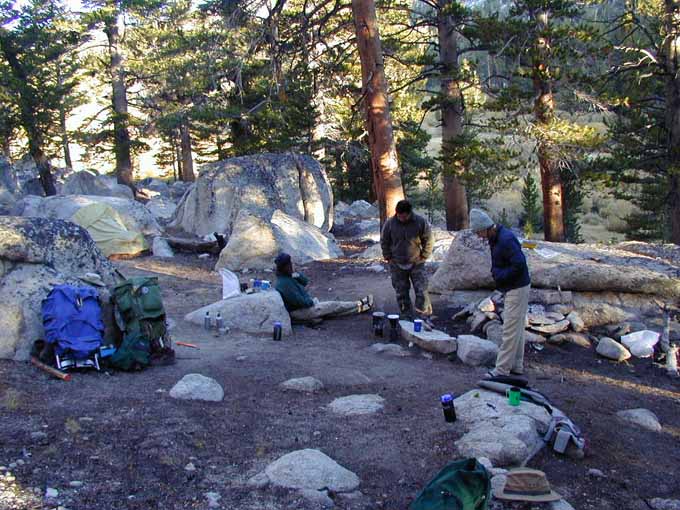
The first order of business in the morning was brewing some Joe.
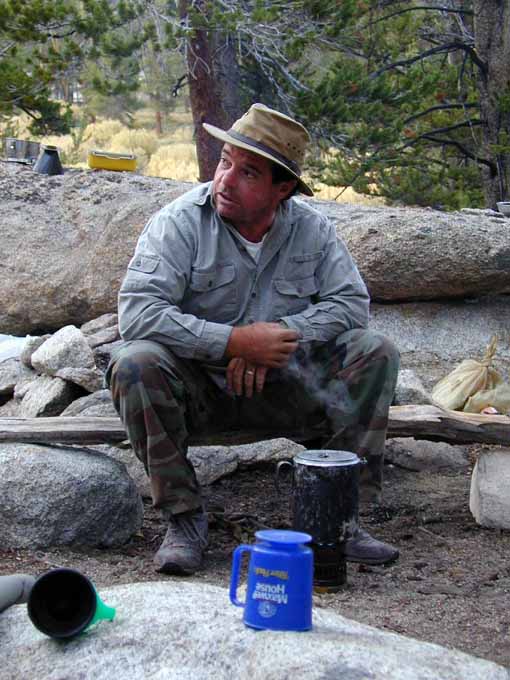
We typically hit the trail at around 10:00, after it had warmed up a tad. We typically returned around 5:00, so we could cook when it was still light. Here, Eddie pours some water into the spuds for the last night's dinner.
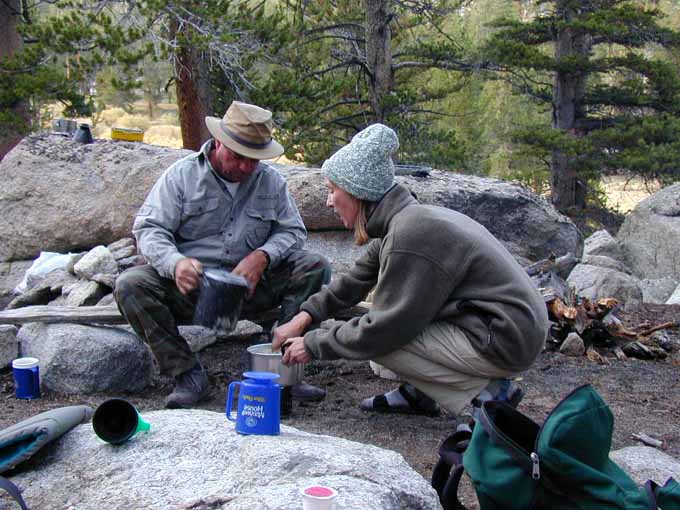
After dinner, it was time for a little nip to take off the chill, among other things. I seemingly have quite a variety to choose from.
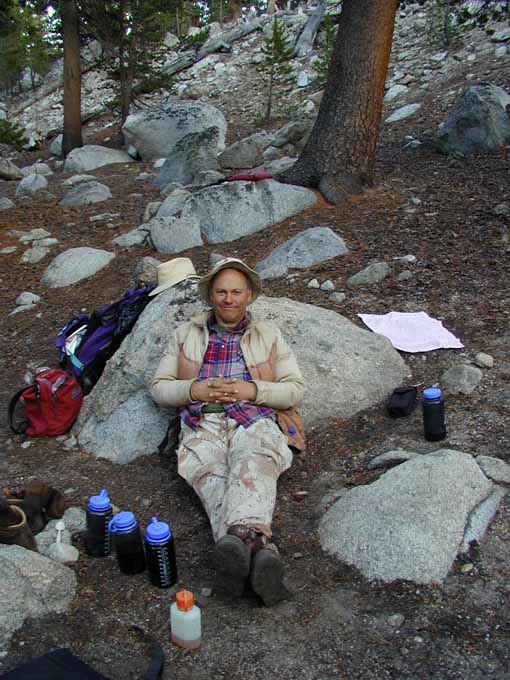
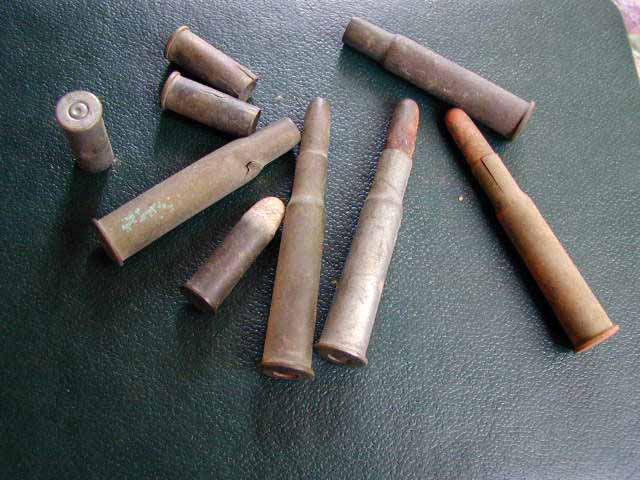
The area next to the meadow was flat and appeared to have seen more use in years past. I figured it was a good spot to do some beeping. I found an old fire ring and started swingin'. Before long, a couple coins from the 1970's and several old cartridges were unearthed. I was finding copper-cased .22s and UMC Co. and USC Co. centerfires. Cartridges are good indicators of a site's use history. If you find copper-cased .22s, it means that the site is pre-1930. Copper was used in rimfire cases and for primers in the days before "non-corrosive" primers were the norm.
The old Union Metallic Cartridge Company (UMC Co.) made ammunition from the 1860s up through 1912 or so. Remington Arms bought UMC and the headstamp changed to REM-UMC. The REM-UMC headstamp was used between 1912 and 1934. They all became part of the DuPont Chemical Company at some point in time. The United States Cartridge Company (USC Co.) had a similar history. The Winchester Repeating Arms Company (WRA Co.) bought USC Co. right about the same time. They became part of the Olin Chemical Company at a similar point in time. Peters also got bought by Remington sometime later, around 1934, I believe. The R-P headstamp in use today is an abbreviation of Remington-Peters. The UMC brand name has seen a resurgence in recent years. Remington is again marketing them.
Now that you've gotten Deano's abbreviated history of antique cartridges, we're ready to go on. As I merrily beeped my way up toward where we were encamped, I began finding military brass. They were rimmed cartridges that looked like old .30-30s. They were in fact, .30-40 Krag cartridges.
The .30-40 Krag was adopted by the US military in 1892. It was really the first modern firearm in the US military arsenal. Modern, in the sense that it used the "new" smokeless powder, it had more punch to the pound, being lighter and considerably more powerful than the old black powder .45-70 round that it replaced. A foot soldier could carry more rounds for the same weight. It had a higher muzzle velocity and thus a greater range and killing power when used against an enemy.
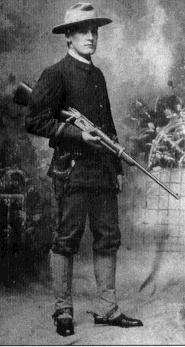
The Krag gave yeoman service under the leisurely stresses of daily military use while in garrison or training. But under the unforgiving eye of combat, it failed miserably. During the Battles of Kettle and San Juan Hill in the Spanish-American War of 1898, the Krag-armed American soldiers engaged Spanish soldiers armed with Model 1895 Mauser rifles. The fire from the Mauser-armed Spaniards tore into the Americans, who suffered heavy losses. It was the casualties inflicted at this battle that caused the American Army to start searching for a better rifle able to compete on equal terms against the Mauser design, which was rapidly being adopted by other military powers around the world. So, it is quite ironic that the Springfield Armory chose to basically copy the Mauser design with its next rifle, the United States Rifle, Caliber .30, M1903 (.30-06 Springfield).
After the adoption of the M1903, the Krag continued to soldier on as a training rifle and in the hands of National Guard troops until after World War I. During the 1930s, the Krag was issued to rural bank guards by the U.S. Treasury Department to help defend the bank against criminals. It was also issued to security guards who guarded strategic production plants during World War II.
As I beeped around, I unearthed spent shell after spent shell casing. I figured that some hunters had gotten a hold of surplus army ammo and had a field day. After continuing to find them, one after the other, I began to wonder. The headstamps varied somewhat. They were "C K 99", "F 98", "F 00", "F 01".

Some were tinned, some were not. "C K" meant they were made in England by Kynoch and were filled with Cordite. "F" meant they were produced by the Frankford Armory. Eventually, I even found three unfired rounds. I also found a number of military headstamped .38 S&W (Smith & Wesson) Specials, along with numerous USC Co. .38s. Very interesting.
With the Civil War and the Gold Rush now fading into memory, the settlement of the American West continued unabated. The 1870s were a time that the ranchers and sheepherders of the Central Valley began looking for greener pastures, so to speak. Rumor had it that the "Fresno Mountains", the Sierra Nevada, had lush pastures there for the taking. Take they did, and for over a decade the onslaught of what John Muir termed "hoofed locusts" began with the spring thaw and ended in the fall before the first snows of winter buried the pasturage. The Kern Plateau, the country just west of the Cottonwood Basin, was a prime target. Large meadows such as Whitney, Mulkey and Templeton attracted thousands of sheep. The vegetation was trampled and eaten; the streams and rivers spoiled. Preservationists such as Muir and George Stewart began their campaigns to end the pillage. Ultimately, in 1890, President Benjamin Harrison signed a bill that created Sequoia National Park, the second national park in the nation.
A paper park at best, the sheepherders, if they even knew what it meant, didn't really give a damn about the new park's status. They needed a little coaxing. Eventually, after patsy Bill McKinley was assassinated in Buffalo in 1901, conservationists got a president upon whom they could rely: Theodore Roosevelt. Although ol' Teddy did most of his wildlife watching down the barrel of his rifle, at least he had an appreciation for the wild lands of the American West. In 1905, he created the Sierra Forest Reserve by presidential proclamation. The Sierra Forest Reserve encompassed most of what are now known as Sequoia and Sierra National Forests.
Administration of the National Parks in the late 19th and early 20th centuries was not the domain of the park ranger as we know them today, but rather, the US Army was charged with administering them. The US Cavalry was also tasked with protection of the newly created Forest Reserve. The Kern Plateau was a long ride from Bakersfield, with Kern Canyon lying in between. Alternatively, the troopers could ride in from Fort Independence in the Owens Valley, to the east. It was certainly closer and arguably easier. A prime location for staging forays into the Kern Plateau was Horseshoe Meadow, our trailhead. Army Pass was blazed by the army making its way from the Cottonwoods into the upper reaches of Rock Creek Canyon.
So why am I telling you all of this? Well, it just so happens that the army used our campsite as what would appear to be a home base, right about 100 years ago! The numerous Krag cartridges were probably used for target practice. Four unfired rounds, three Krags and one .38, were also retrieved.
The targets may have been purple glass bottles, as shards of various shades were encountered. This set of brass spurs had the wheel completely rusted away.

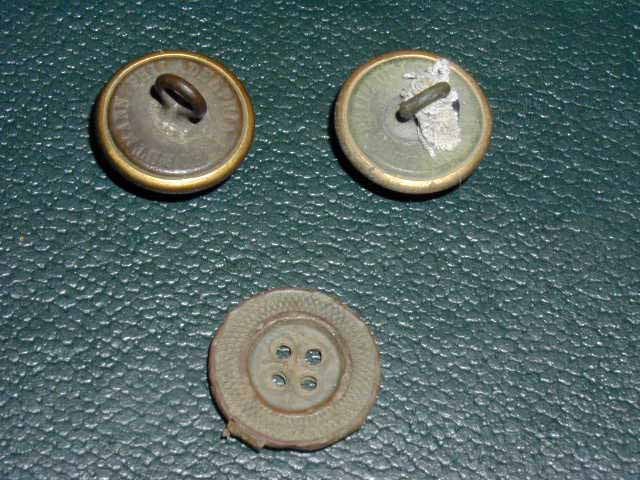
Well, that's nice speculation, but the clincher was the discovery of not one, but two buttons lost by the "bluecoats". The other button's origin is unknown, but it was found in roughly the same area.
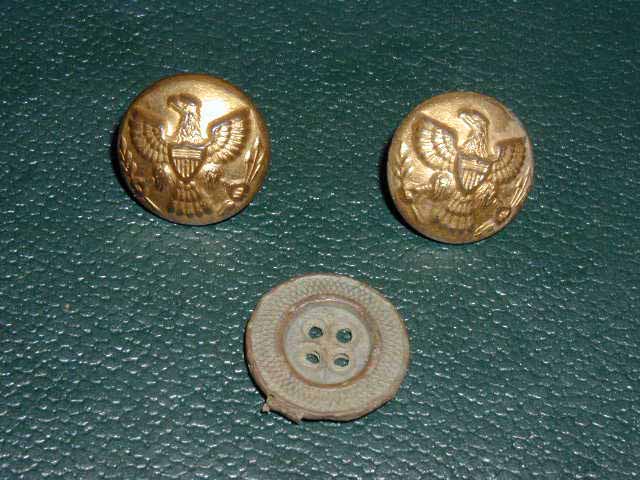
The gold plating was in good shape and on one button, some of the thread was still intact. They were made by Horstmann - Philadelphia.
The bad news was I didn't find even one coin!! My speculation is that the army didn't allow the soldiers to bring any money with them. Its only use would have been for gambling, and the commander probably figured he had enough problems without having to referee petty disputes. Plus, back in those days, many of the troopers were paid in Army Script, usable only at the Post Exchange.
Digging up all these 95 year old cartridges and stuff was interesting, but a few Indian head pennies, V-nickels and Barber dimes, quarters or halves would have made it stellar. That's one thing about beepin'....you just never know.
